A farmer cutting hay on a steep slope above the Engadin valley collects more than twice the per-hectare open-landscape payment received by a farmer on the Mittelland plateau. The disparity is not an accident. Swiss policy deliberately channels its largest transfers to the country’s steepest, highest and shortest-season land to keep the Alps farmed and the cultural landscape open. The public goods are genuine. But the system rests on an assumption that no longer holds. The payment map was designed for climatic conditions that have since changed.
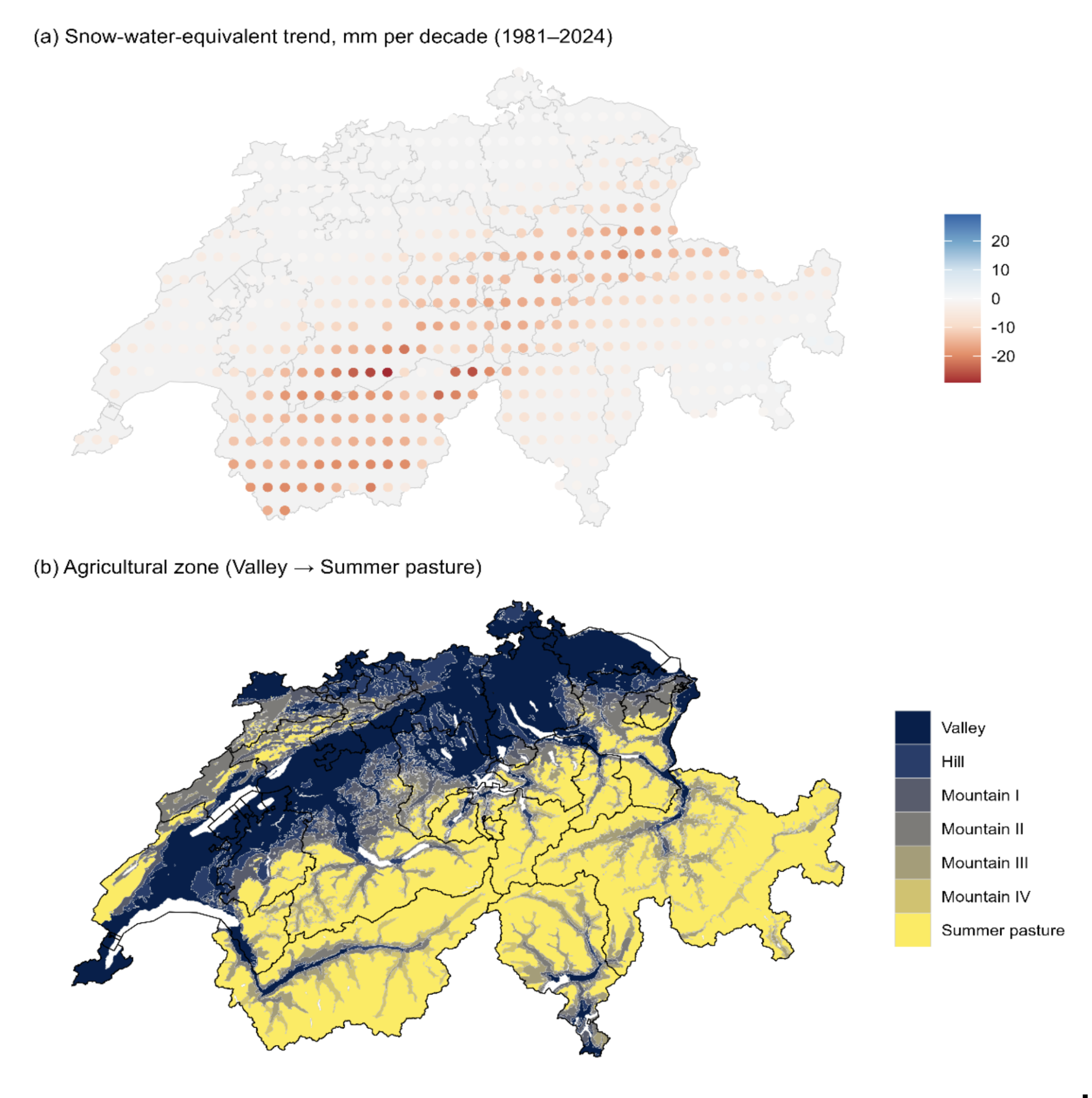
The seven Swiss agricultural production zones – valley, hill, four mountain bands and the summer-pasturing region divide the farmland by altitude, slope, season length and accessibility. A fixed administrative map of the country sorted by farming difficulty is available on the federal geoportal. These boundaries have not been redrawn for a warming climate, and the per-hectare rates attached to them have barely moved. Between 2014 and 2024 the open-landscape payment changed by 0.2 per cent. Adjusted for inflation, it has lost almost six per cent of its real value (author’s calculation). The map is frozen.
The Alps are not. European mountain climates warm at roughly twice the global mean, and the change is concentrated at altitude. In Switzerland’s mountain zone IV, the highest of the area-payment categories, the snow is thinning by about 13 millimeters a decade, measured as the water it holds. In the valley zone, the decline is 2.4 millimeters per decade. Thus, the country’s most-paid land loses snow more than five times faster than its least-paid (author’s calculation from the ERA5-Land reanalysis, 1981-2024).
In my own research, currently under peer review, I measured how closely payment levels track where snow is disappearing fastest. Comparing hundreds of points across the Swiss Alps, I find that snow loss steepens by an additional 5.3 millimeters a decade for every extra CHF 100 per hectare a zone receives. In plain terms: the more a zone is paid, the faster its snow is vanishing. Where transfers are highest, the climatic basis for those transfers is eroding fastest.
The contrast with the United States is revealing. In the US Corn Belt, federal crop insurance broadly follows agronomic capacity, and this can blunt farmers’ incentives to adapt to extreme heat. The Swiss configuration is the mirror image. Payment here runs deliberately toward climatic difficulty, because what it buys — open landscape, semi-natural grassland, alpine settlement – has nothing to do with agricultural productivity. Swiss support does not mask the climate signal; it is indexed to it. And the signal it tracks is quietly moving.
This matters because several policy debates are open right now. The European Scientific Advisory Board on Climate Change recommended in early 2026 that slow-onset climatic change be reflected in the mapping of the EU’s Areas of Natural Constraint. Switzerland’s parallel zonal system sits outside that recommendation, yet the underlying question is identical. AP 2030, the next Swiss agricultural reform, opens a window in which the boundaries could be revisited. So does the regulatory dialogue running through Bilaterals III.
The argument is not that high mountain zones should be paid less. The public goods they supply are valuable, undersupplied by markets and increasingly urgent. The question is whether a policy designed for yesterday’s climate still works in today’s conditions.
Three responses are conceivable. Zone boundaries could be updated regularly to reflect changing climatic conditions. Payments could be linked to measurable indicators such as snow cover or growing-season length, so that compensation moves with the conditions it is meant to address. Or payments could increase in years when mountain farming faces unusually difficult conditions. Each carries administrative cost and political friction. None is obviously the right answer. None has been seriously debated.
The research does not tell policymakers which solution to choose. It measures the gap between what the law has frozen and what the atmosphere is doing. That gap widens every winter.
Switzerland will continue to pay against the climate, and it should. The remaining question is whether it keeps paying against the climate of 1995, the climate of 2014, or the climate of next year.